

The 2nd session of our 3 Dialogues series, on “Sustainability”, was held at Turquoise Harmony Institute in Cape Town on the 2nd July 2025. Geordie Ractliffe, a freshwater scientist and activist, and co-founder of the “Sustainability Matters” NGO, spoke alongside Sheik Ismail Keraan, a long-time community spiritual leader of Al Azhar Mosque at the heart of the District Six community.

Geordie, differentiating between knowledge and understanding, offered a a “systems” view. For example, a glass of water is not a “thing”, but rather a “property” of an emergent system. If that system is healthy, the water will be life sustaining. But if the system is unwell, that water might be poison. Un-interrupted by human meddling, nature sustains itself. In nature, there is no waste. But in human economies, waste proliferates, as does want.
Also, efficiency is not the way of Nature. From a human point of view, Nature is “wasteful” – super-abundant and profligate – and yet its Way has inherent wholeness, or sustainability.
As an example Geordie pointed out that under the first Trump administration, so-called “wasteful” services to the US public were sacrificed as “inefficient” and led to breakdowns in many areas of that society. (How much more now, with the DOGE attitude of taking a chainsaw to many key dimensions of American life, health, education and ecology, for example).
Sciences’ call is then is understand the perennial “Way” of the Earth and live by it.

Sheik Keraan for his part, stated that 2 key dimensions had been eroded in our time were Truth, and Trust. The fragmentation that he and his community felt when evicted from their District Six home in the late 1960’s by the Apartheid regime, is a big part of the scar on the South African psyche. This fragmentation persists, as many aspects of our young democracy struggle to recover from such ethnic cleansing experienced at the hands of a demonic system.
As he often does, Keraan related to a time of social cohesion well inside of living memory where “the streets were the passages and the houses, the rooms”. Despite its poverty, the social system of District Six functioned through the trust of its people with one another. To fling this well-woven network of human relationship onto the Cape Flats, was a grave crime by poisoned minds bent on artificial separation and racial supremacy.
So where does the science of sustainability meet spiritual leadership? To those present, the answer will be in the very dialog held. Instead of contesting between faith and science, both Geordie Ractliffe and Sheik Ismail Keraan affirmed that Truth – Understanding – must be our foundation. As healthy earth systems needed to be respected as the very foundation of life, so human society must not be coerced for ideological gain; humans too have the potential to live closer to this Way.
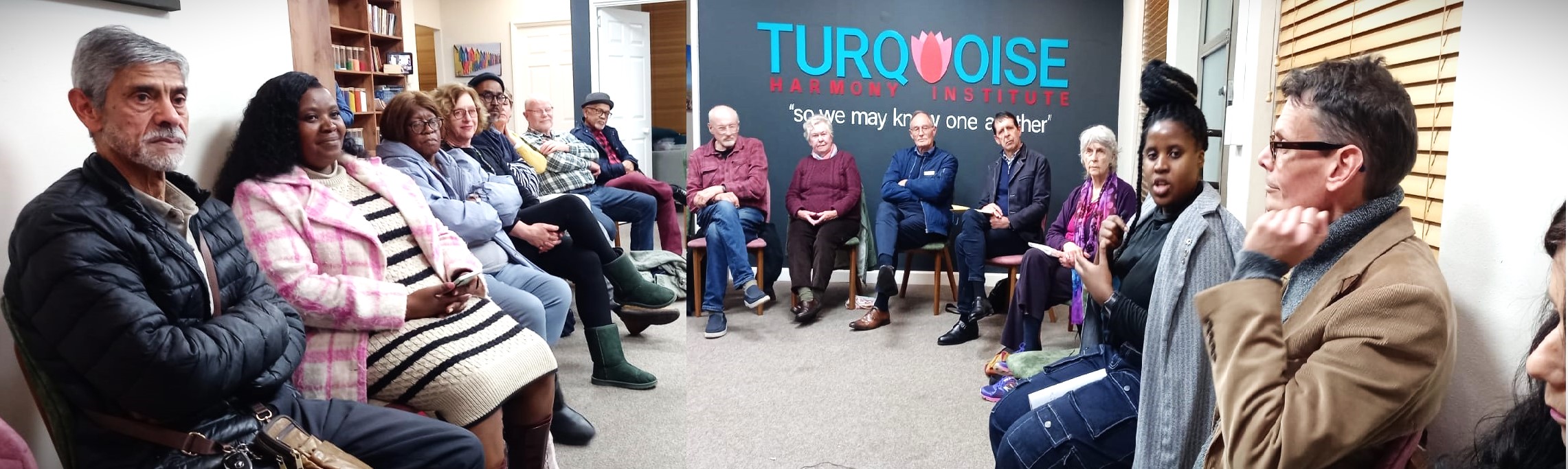
Many other voices joined the discourse. One attested to the fact that the Church, which had been part of the problem of Apartheid, self-corrected and became a part of the solution – a free(r) and (more) democratic society. This was one example of how we might re-imagine a future that is different.
Sheik Keraan closed his contribution with some very pertinent quotes, most notable perhaps that of Alvin Toffler, who said
“The illiterate of the future are not those who can’t read or write but those who cannot learn, unlearn, and relearn.”
As we take part in the wider G20/IF20 and National Dialogue, in addressing its themes, let us expand and deepen our ideas of what constitutes the sustainable. Let us turn to some indigenous wisdom, such as this from North America:
“We do not inherit the Earth from our ancestors, we borrow it from our children”.
If we can transcend the individualism of contemporary culture, and shallow understandings of ecology, we see a continuity between what has preceded us and that which goes ahead. The decisions we make are not merely for our own comfort or gain, but to build future generations.

In societies like South Africa with widespread poverty, many do not have the luxuries of time, resources and options. Therefore, the vicious cycle of short termism continues as people’s lives are taken up with the question of their next meal.
Sustainability, then, is a question of people and of planet, but is often made obscure by the new rationale of oligarchy: profit and short-term gain.
May both the Faith as well as the Scientific communities work together for the common good of all – people, planet and all part of this universe. Like the community who attended this dialog, may we further dovetail in understanding and in intention, building a better life for all.

