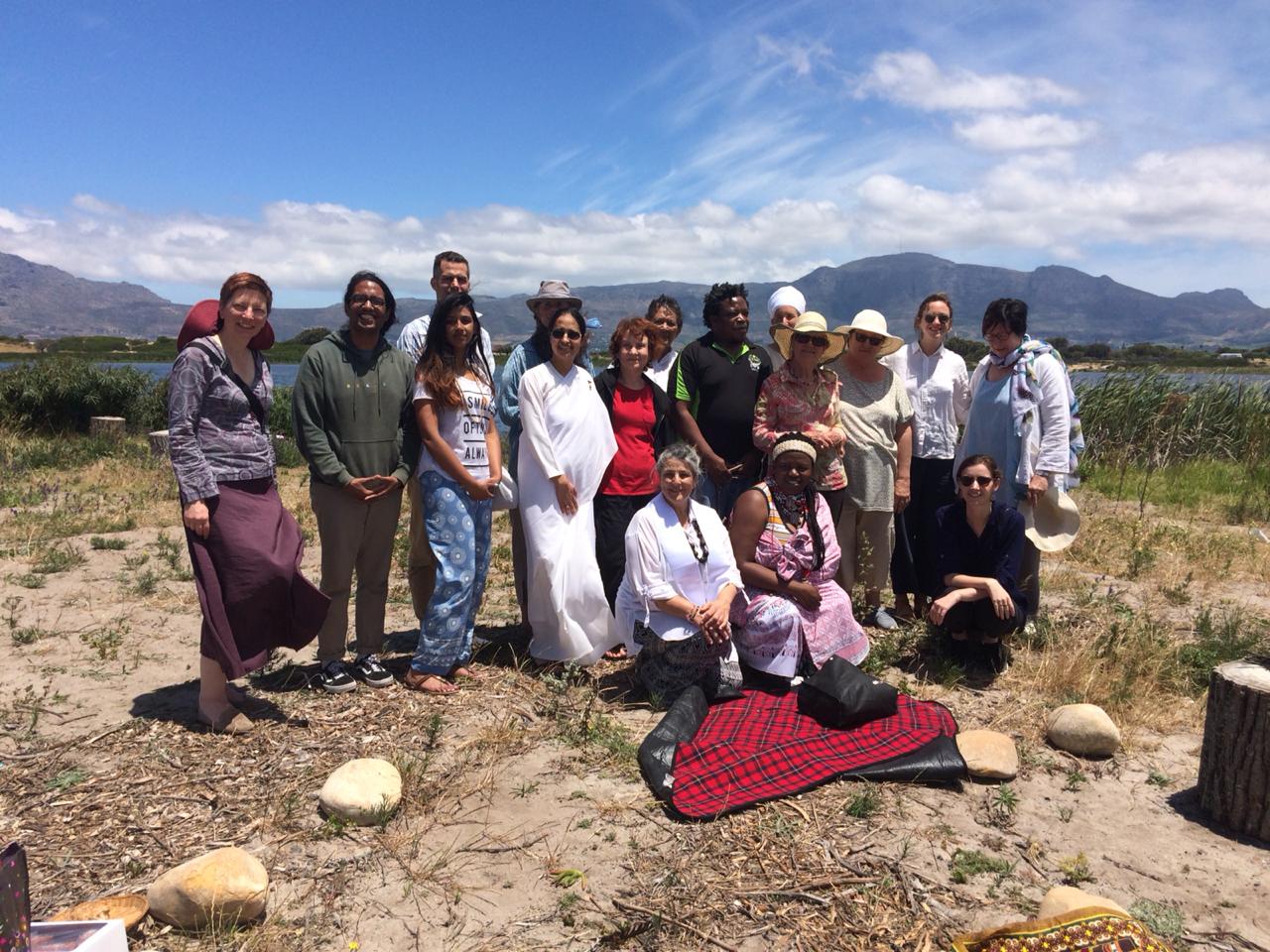
On 19 September the Emissaries of Divine Light hosted a Peace work shop at their sanctuary in Brommersvlei Road. I was very honoured to be the facilitator. We looked at Peace, what it means and how one would define it. Then we looked at how one would explain that concept to any person who has never experienced it. We had no answers for that, but we did end the evening with the realisation of how easy it is to give up and become disillusioned and how important it is to resist that urge. Once we have the privilege of knowing what peace is, we have a responsibility to hold that vision for those who have not yet managed to embrace that experience. That’s how the energetic field is both anchored and expanded.
Thank you Howard Goodman of the Emissaries for making it happen, we’d love to do that again.
The turnout may not have been what we hoped for, but the message certainly was. On 20 September we celebrated International Day of Peace a little early with our Silent Prayer Peace March from Kaizergracht to Parliament where we handedover a memorandum to Mr Charles Ford of the Office of the State President.
The timing was perfect as the Honorable President was in New York for the IDP Summit commemorating the 100th birthday of Nelson Mandela. The theme was The Right To Peace, and it spoke right into our memorandum as we reminded the State President of the human rights enshrined in our constitution – the rights to Freedom, Dignity and Security, all of which are not the lived experience of the majority of our people.
We urged the Government to take action to secure these human rights in our communities, and we asked for engagement that would re-motivate the law enforcement agencies to effectively do their jobs. We cited unequal distribution of resources as just one of the problems that could be easily rectified, and we quoted the Golden Rule that flows through all faiths as the unifying factor in our alliance as Faith Leaders as we work to restore the moral compass and reassure the people and the President that Spiritual Leadership has an important role to play in bringing back law and order and a sense of stability to our communities.
Cape Town Interfaith Initiative has pledged its support of the No Place for Hate Campaign, and we invite you to do the same!
We pledge to do everything in our power to promote peace and understanding between people of diverse faiths and belief systems. We will live our truth, choosing always the path of love, compassion and respect.
This message is simple – there can be no space for hatred in South Africa.
We live in a country with constitutional ideals which echo our commitments to shared humanity, dignity, freedom and life.
Through “No Place for Hate”, we will fight hatred directed against anyone to combat a culture of racism, antisemitism and prejudice in our country.
Show your support for the campaign in either a personal or professional capacity. It’s totally free and you get to use the campaign logo to publicly show you are actively supporting No Place for Hate in South Africa.
The City of Cape Town hosted an Interfaith blessing of the Newlands Springwater at the new collection point on Tuesday the 22nd May. What a special moment! The rains were included in the ceremony, and the Water and Sanitation Department shared some interesting background to their very challenging task. This beautiful event included prayers and blessings from many traditions including Baha’i, Buddhism, Hindu, Islam, Judaism, Catholic, Unitarian, Anglican, AfricanTraditional and Quaker.
James (second from left) with fellow delegates, visiting a Mosque in Blantyre, Malawi
James Ellman, CTII Director, recently represented the Cape Town Interfaith Initiative at the United Religions Initiative (URI) Regional Assembly in Malawi. The Regional Assembly brought together all the Cooperation Circle (CC) leaders, from South Africa, Mozambique, and Malawi. The Cape Town Interfaith Initiative has been a Cooperation Circle of URI since 2014. James described the experience as follows;
“The Malawi experience with URI has brought together people from various backgrounds throughout Southern Africa. It was an opportunity to learn from the various representatives about the challenges they face and how they respond to these challenges. I was inspired by the way they deal with their challenges using non-violence as their vehicle to respond.
CTII also shared experiences and participants were encouraged by the way CTII makes interfaith interaction a reality. CTII is seen as a beacon of hope to them guiding the way of getting involved in interfaith dialogue.
The 2017 URI Regional Assembly Delegation
The one challenge I found that most of the organisations present shared, was getting funding for the great work being done. People in Malawi and Mozambique live in extreme poverty but they are positive and keep moving forward making a difference one step and one person at a time. Living in South Africa, I also see poverty and I am re-inspired by these CCs to stay faithful to the vision of CTII.
One of the main outcomes of the regional assembly was that a work plan was set up for the journey forward into 2018 and beyond for URI Southern Africa.”
Thank you James for sharing the experiences of CTII and being a voice for interfaith dialogue at this important gathering!