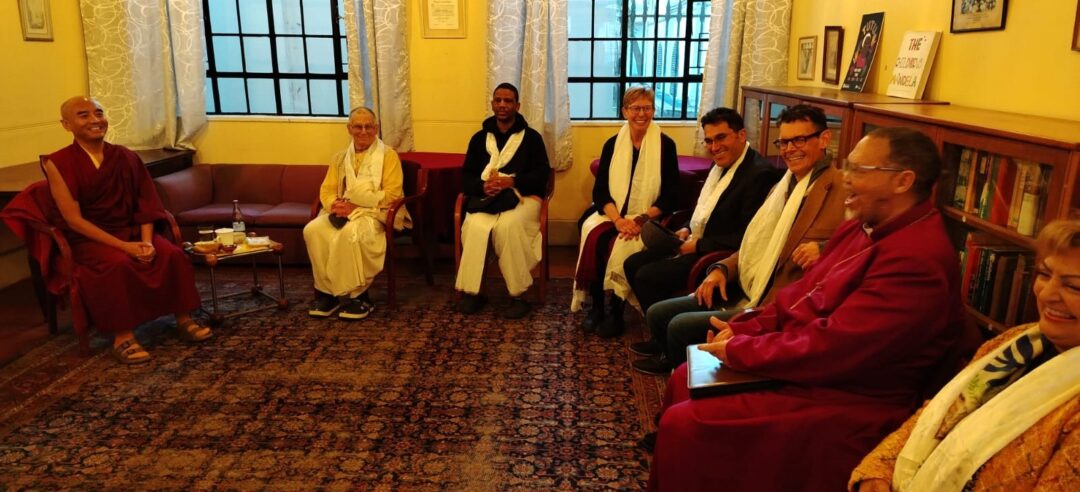
Reflections on Welcome: Boundless Compassion with Mingyur Rinpoche
By James Guebert
I attended the Boundless Compassion evening hosted by Mingyur Rinpoche as a volunteer to help the CTII students practice their skits and, like all attendees, to witness and participate in a beautiful interfaith space designed to bring people together and foster peace in Cape Town.
As I took my seat, the evening opened with a moving land acknowledgement and short ceremony inviting the ancestors into the space. From the very beginning, the message was clear: this was a place of welcome. This sense of hospitality carried substantial weight in St. George’s Cathedral.
One of the first words offered that night stayed with me: “Faith is not just about saying no—it is about saying yes, together with one voice.” This framing carried through the evening as the interfaith choir sang. Their harmonies gave a beautiful sound to that “yes”: yes to peace and yes to boundless compassion.
For the teachings and speakers, Ubuntu was the thread woven through the program as various speakers offered thoughts and perspectives. Intentionally diverse speakers deepened this theme, connecting compassion with the identity of God, reflecting on ancestral trauma and forgiveness, and offering reminders that difference can breed respect and does not need to cause division—or in other words, boundless compassion. The students of the CTII program added their voices with honesty and passion, asking in their own way:
Who am I? Who are you? Who are we?
The idea of Ubuntu particularly came alive during Lama Mingyur Rinpoche’s provided periods of silence and meditation on common themes together, which prompted the entire group to be united in mind. For me at least, that silence did not go uninterrupted. Sitting near the door, I could hear cars screeching, bass lines pulsing from nearby speakers, and now and then, a baby crying.
That contrast struck me. Inside, all people were invited into stillness, into a sacramentalized welcome, but even as we closed the door you could feel the outside rushing in, disruptive and much less organized. It allowed me an opportunity to reflect on how fragile such a “sacred space” can be—how difficult it is to look inward when distractions press in, and how easily a welcome can become an opportunity for isolation rather than a door that remains open behind you.
As the evening drew to a close, each of us was given a candle. I stared at the small flame in my hands while the choir sang una voce and the audience meditated. Outside, the noise only seemed to grow louder as the evening festivities in Cape Town were beginning. And then came the final instruction:
With that, the boundary between the cathedral and the street seemed to dissolve and the welcome extended outward. The hospitality, compassion, and unity is no longer inside, but wherever we carry it—a hefty thrust of responsibility and one requiring both sustained reflection and action from the evening’s attendees.