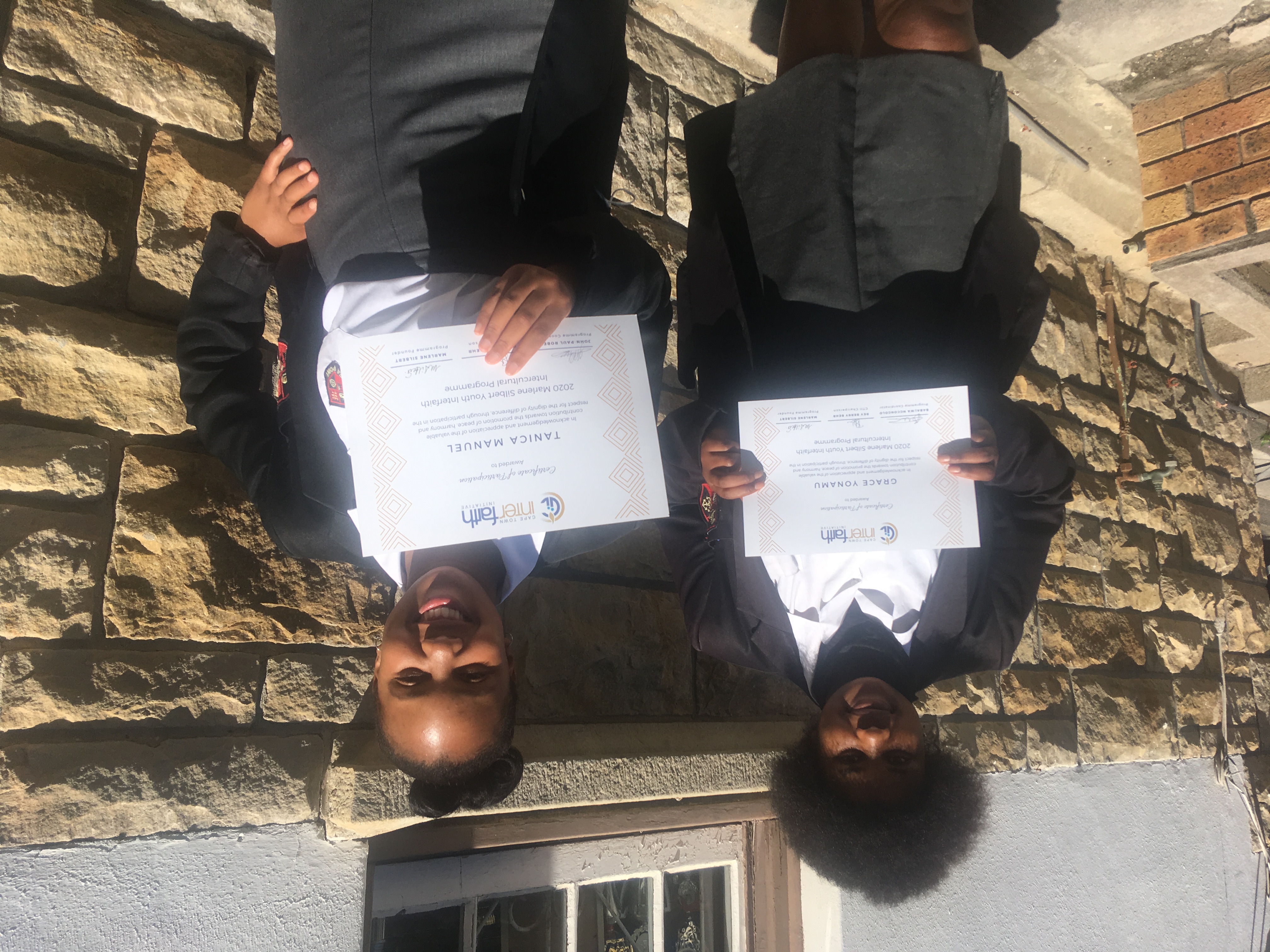
Celebrating the Grade 10 learners of MSYIIP

Despite the very different year it has been, our schools programme ended with smiles (albeit behind masks!), as we were able to successfully visit all the schools that participate in the Marlene Silbert Youth Interfaith Intercultural Programme, and hand over certificates to this years cohort of Grade 10s.

This year the programme has had to adapt to moving to an online curriculum, which has offered learners a new opportunity to engage in rich content covering the programme themes of youth activism, social justice and peace-building. We were delighted to be able to award all participating learners with a unique certificate to mark the completion of the year.

We’re so grateful to each of these incredible learners for their commitment to creating peace, justice and healing in the world. We hope you enjoy these pictures below!

Asemahle and Clementine from Spine Road High

IMG_7595 IMG_7556 IMG_7520 b72170b4-713c-47cb-b8ab-bd26929d409f

WhatsApp Image 2020-11-27 at 12.26.22 (1) (1) IMG_7705 IMG_7678 b2293774-4e59-41e5-8949-10362320e325 8c9c509b-a68d-402e-ae3b-29a79a54ec32

Schools Programme Mid-Year Report

In this new and constantly emerging world, we need young people who are ready to take the lead with passion and conviction, grounded in values of social justice and compassion, and equipped with skills of critical thinking, dialogue and leadership.

The Marlene Silbert Youth Interfaith Intercultural Programme strives to achieve exactly this. We believe in this current moment our programme is more relevant than ever in providing young people with the skills that will help them reimagine a post-covid world.

It is our pleasure to update you on the progress of the Marlene Silbert Youth Interfaith Intercultural Programme, for 2020, which you can read the details of in this report:

MSYIIP Progress Report 2020

In beginning the year, we were able to successfully start the programme with 9 participating schools contributing a new cohort of Grade 10 learners. We were particularly pleased this year to have learners from Langa High School join the programme, through a partnership with the organisation Just Grace.

We were also pleased to begin the year with a full Programme Coordinating Team – led by Babalwa Ngcongolo, John-Paul Roberts and Sarah Oliver. Sarah has worked on the programme for the last three years, along with Rev. Natalie Simons-Arendse. Babalwa and John-Paul were both facilitators on the programme in 2019, and so we are very pleased to have their skills and expertise in a leadership role this year. This is made possible through our continued partnership with the GOAL Trust – Giving Opportunities to Aspiring Leaders.

As you will read in the attached report, this year has had its challenges with the changing world due to the COVID-19 pandemic. We were fortunate to be able to hold our annual 5 day camp programme at the beginning of the year.. Highlights of this camp experience included having participants share a significant part of their religions and cultural traditions with each other, in the spirit of interfaith dialogue and respect. Other highlights involved learning about topics such as power, privilege, gender and sexuality, responsible citizenship and leadership. The most impactful part of camp is the sense of deep connection and unity felt in the group. The facilitators of the programme are very intentional about creating a safe space, where learners feel free to express themselves and build friendships based on trust, kindness and authenticity. We encourage you to read the attached report, which includes comments from the learners themselves.

IMG_6596

With the changes necessitated by COVID-19, the programme too needed to adapt, making sure to always hold true to our purpose of building social cohesion, interfaith dialogue and peace between high school learners from different faiths, traditions and socio-economic backgrounds. Empowering young leaders to respond critically and consciously to the world around them is a critical outcome. Due to not being able to gather physically, we had to re-think what the programme would look like for the rest of the year.

We are proud to share that we have risen to the challenge, with the development of an online
curriculum, which has allowed participants to continue their engagement with each other and learn about relevant topics such as youth activism, social justice and human rights. The virtual learning site has been accompanied by monthly online meetings as well as conversations in dialogue groups through Whatsapp. New challenges such as costs of data and lack of internet access have emerged, which has been a barrier for some in participating fully in the programme. This is very concerning for us, as we work on a principle of inclusion, and we want to make sure that everyone has access to the full experience of the programme. Going forward we are working to be innovative and creative in making sure all participants have full access to being a part of the programme.

MSYIIP Online Group Photo

While our Grade 11 Tutoring year had to be put on hold, again due to the coronavirus, we are taking time to reimagine what a Grade 11 year of action can look like, and are confident that from next year the programme will launch with a powerful cohort of Grade 11’s who are ambassadors of peace, healing and justice not just in their schools, but their communities and country as well. With the coronavirus, we have also had to face the challenging situation of some funders changing their priorities to focus on COVID-19 relief efforts. While this is of course crucial, it has meant that our programme budget has been reduced, and we are in an urgent position of needing to ensure financial sustainability at a time when our programme is more relevant than ever in providing young people with the skills that will help them reimagine a post-covid world.

We invite you to join us on this journey and welcome your input and feedback!

No Justice, No Peace: Know Justice, Know Peace

“We envision and embrace a country and peoples unified by interreligious and spiritual understanding and respect.”

The 7th of our 8 objectives calls upon us to generate good coexistence values.

CTII stands in solidarity with an urgent call by the Rabbinic leadership of the South African Union for Progressive Judaism and others, to President Cyril Ramaphosa to ensure justice for the 11 citizens killed during lockdown and for all those who have suffered indignity and violence at the hands of South African police officers. The tragic deaths of Collins Khosa, Petrus Miggels, Sibusiso Amos, Adane Emmanuel and others are unacceptable breaches of a security force entrusted with the care and safety of the people.

To call these 11 deaths an act of over-enthusiasm is to belittle, dismiss and subtly condone a deeply disturbing trend of brutality of government’s law enforcement agencies against the very people our armed forces and our leadership are sworn to protect.

South African courts have demanded an end to the violence, and yet it has continued and even appeared to escalate.  People have continued to lose their lives, livelihoods and freedom due to “over-enthusiastic” action by security agents. We ask our President where this blatant disregard for law comes from, and why it is being allowed to continue so rampantly, with apparent impunity.

At this time of heightened trauma due to the Covid-19 pandemic, in an already traumatised society beset by inherent injustices, we ask the President to mindfully consider the Government’s duty to maintain safety, calm and security. Brutality and violence can never be regarded as a path to safety, calm and security. Neither can hunger, and we note that the inability of many people to access basic food requirements has been a contributing factor in the developing conflict between the state and the population.  The lack of food security must be seen as another form of violence perpetuated on a disempowered nation. We refer to our Constitution which promises an environment free from danger and violence, and enshrines the right to adequate food and water. We encourage the South African Government to take seriously the mandate of the Constitution.

South Africa is a deeply religious country with a vibrant diversity of faiths. All our religions without exception speak the language of peace, compassion and respect. We invoke the Golden Rule that lies at the heart of all our beliefs: Do unto others as you would have done unto you.

Mr President, there can be no peace where there is no justice. And we will know peace when we know justice. May peace prevail on Earth, and may it begin with us.

CTII Statement on Religious Gatherings during Level 3

Cape Town Interfaith Initiative welcomes the announcement of a national day of Prayer on Sunday 31 May.  We also applaud the designation of Faith Leaders as essential workers in the amended Government regulations announced on Tuesday 26 May by President Cyril Ramaphosa.

We see this as an acknowledgement of the pivotal role played by leaders of all faiths in maintaining the emotional and spiritual wellbeing of their communities.

We call upon the government to further support and honour the role of faith leaders through the provision of a specific allowance for faith leaders, particularly those providing a service to economically challenged communities. Many have been severely compromised during the Covid-19 period as the disallowing of gatherings cut them off from earnings in the form of financial offerings collected during services in places of worship.

We also call attention to the possibility that the need for financial support could place some faith leaders in the difficult position of being under pressure to reopen their places of worship before they are reasonably able to meet the criteria laid down in the government guidelines. The financial and logistical implications of meeting the requirements are considerable.  Many places of worship will be unable to comply and will therefore be duty bound to remain closed, compounding the stress on the faith leaders as well as their communities.

CTII appreciates Government’s engagement with faith communities, and the difficulties of catering to all needs at this challenging time. However, we draw attention to the burden of responsibility on faith leaders who continue in many instances to serve whilst they themselves live in penury.

Faith communities and their leaders have traditionally been points of transformation in South Africa. We embrace this opportunity to encourage and lead social transformation. We call on Government to empower this necessary process with specific, targetted financial support.

Many faith leaders have moved forward creatively, staggering services or implementing rotational systems of gathering. Others have taken the difficult but sensitive decision to remain closed for now.  Pastoral care remains a priority for all. As one congregant said: “The church is the people, not the place.”  We urge those responsible for places of worship to exercise extra caution and discernment in their responses. All faith leaders should prioritise continued hygiene protocols including sanitisation of buildings and adherence to the personal protocols of wearing masks, keeping physical distance and hand washing, thereby upholding the sanctity of life and helping to keep environments as safe and Covid-19 free as possible.

CTII encourages prayerful consideration of the implications of our responsibility as Faith and community leaders, and remains committed to promoting understanding, dialogue and right relationship amongst members of all faiths in accordance with the Golden Rule, the Charter for Compassion and our own mission statement.